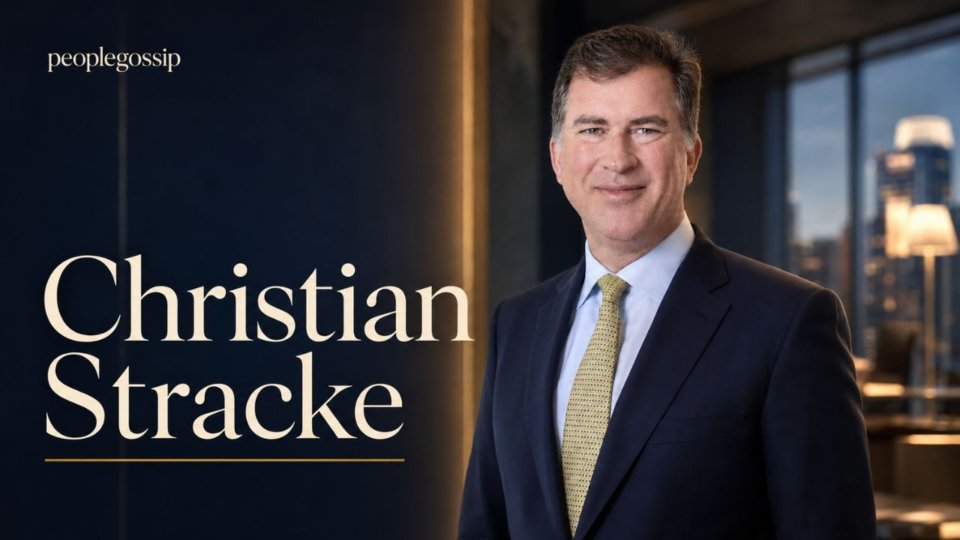
Christian Stracke is a managing director and president of PIMCO, the investment management firm he joined in 2008. Based in London, he oversees the company’s operations outside the Americas. His responsibilities include international strategy, distribution growth, and the expansion of PIMCO’s private strategies platform.
His present position follows nearly three decades of investment experience across credit research, emerging markets, and portfolio strategy. Stracke previously led PIMCO’s global credit research group before transferring that responsibility in 2025. His public comments now cover international markets, private credit, portfolio resilience, sustainable finance, and the regulation of financial technology.
From Global Markets to PIMCO
Stracke holds an undergraduate degree from the University of Chicago. PIMCO does not identify his field of study or graduation year, but its current profile credits him with 29 years of investment experience.
Before moving into finance, he volunteered with the Peace Corps as an agroforestry extension agent in Mauritania, West Africa. Both PIMCO and Marymount High School confirm that assignment. Reputable reporting places the service between 1992 and 1994, although the official profiles do not provide exact dates.
His early financial career developed around credit and Latin American markets. At Deutsche Bank, Stracke headed Latin American local-markets strategy. He later led Latin American fixed-income strategy at Commerzbank Securities and worked as a senior credit strategist at CreditSights.
These roles established his documented experience in credit research, Latin American fixed-income strategy, and local-markets strategy. In 2008, he joined PIMCO and eventually became a senior portfolio manager, global head of credit research, and member of the firm’s Executive Committee.
Taking Charge of International Operations
An institutional report prepared by investment consultant NEPC states that Stracke relocated to London and became PIMCO president in June 2023. He initially continued to lead global credit research while taking responsibility for a broader international business.
PIMCO’s current leadership profile identifies Christian Stracke as president and confirms that he oversees operations outside the Americas. That remit covers Europe, the Middle East, Africa, and the Asia-Pacific region. His work includes shaping strategy, expanding distribution, and developing the firm’s private-investment capabilities.
The position is broader than a traditional market-research role. It combines business management with an understanding of public and private credit. Stracke also remains on PIMCO’s Executive Committee and serves on committees related to alternative credit and private strategies.
From London, he delivers public discussions on capital flows, regional market conditions, geopolitical disruption, and international investment opportunities.
Transition from Credit Research Leadership
Credit research remained a major part of Stracke’s responsibilities during his first two years as president. He oversaw analysis at different levels of the company’s debt, including investment-grade and high-yield bonds, bank loans, and convertible securities.
That arrangement changed in 2025. According to NEPC, PIMCO informed the consultant on June 20, 2025, that John Devir had been named global head of credit research. Devir replaced Stracke in that position, allowing the president to focus more closely on international operations and growth outside the Americas.
PIMCO’s current profile now lists Stracke as president but does not describe him as the global head of credit research. It continues to refer to him as a senior portfolio manager and a member of several investment committees. NEPC offers additional context, reporting that he does not handle day-to-day portfolio management and instead serves on committees more as a sounding board.
The two descriptions concern different aspects of his position. He retains senior investment responsibilities and committee involvement, while his daily attention is concentrated primarily on PIMCO’s international business.
His Approach to Uncertainty and Risk
Stracke has explained his investment process most clearly in direct professional interviews. During a PIMCO podcast in March 2026, he described scenario analysis and portfolio stress testing as important parts of working through uncertain conditions.
Rather than relying on a single forecast, the process considers several realistic ways that events might develop. Stracke said PIMCO consults specialists who understand areas such as geopolitics, commodities, and emerging markets. Their knowledge helps the investment team separate plausible outcomes from scenarios that are too remote to guide useful decisions.
Once those possibilities are established, the firm considers how each one could affect portfolio construction. Stracke linked prolonged uncertainty to reduced risk, greater liquidity, and a reconsideration of familiar relationships among asset classes. Historical patterns may remain useful over long periods, but he warned that they can break down temporarily and create unwelcome surprises.
His comments in a 2025 Wells Fargo corporate feature followed a similar principle. Stracke said a portfolio should not work only when conditions develop favorably. He emphasized downside protection alongside the search for returns and described clear communication of potential risks as part of serving clients.
Views on Public and Private Credit
A recurring subject in Stracke’s public work is the changing relationship between banks and asset managers. He has argued that banks are reducing lending activity in certain areas, creating room for investment managers to provide capital.
He does not present that development as the disappearance of traditional banking. In an official PIMCO discussion published in October 2025, Stracke described a hybrid system in which banks and asset managers play complementary roles. Large financing arrangements that banks might once have originated and distributed entirely within the banking system can increasingly involve institutional investors.
Stracke draws an important distinction between different forms of private credit. In a January 2026 Bloomberg Intelligence interview, he warned that some investors were overlooking risks in private debt while pursuing higher yields. His concerns included limited disclosure, concentration in particular sectors, weak borrowers, and the absence of transparent market pricing.
He also noted that loans made during the low-rate period earlier in the decade could remain under pressure for years as borrowers face higher refinancing costs. Smaller companies may have less financial flexibility than businesses with access to public debt markets, making careful underwriting especially important.
His outlook is more constructive on asset-based finance, in which lending is supported by identifiable assets or cash flows. Stracke has connected opportunities in this area to bank retrenchment, while continuing to stress the need for detailed analysis and appropriate protection against losses.
Sustainable Finance and Institutional Service
Stracke’s work outside PIMCO includes involvement with the United Nations Global Compact. In December 2022, he was appointed co-chair of the advisory board for the CFO Coalition for the Sustainable Development Goals. The appointment covered a two-year term.
The coalition brings together finance executives, investors, financial institutions, and UN agencies to develop approaches to incorporating the Sustainable Development Goals into corporate investment and financing. Stracke directly supported its aim of building an international group of financial leaders committed to SDG-aligned finance.
He has also stated that private capital can contribute to social, environmental, and economic goals when investment decisions are grounded in credible sustainability principles. In September 2023, he participated in a UN Global Compact Leaders Summit session focused on systemic changes in corporate finance and the 2030 Agenda.
His institutional service also extends to education. For the 2025–2026 school year, Marymount High School listed Stracke as a trustee in his fifth year. He serves on its Finance Committee and chairs the Investment Sub-Committee. The school confirms those positions but does not identify any individual initiatives he led.
Expanding His Public Focus
As his international responsibilities have grown, Stracke’s public comments have extended beyond conventional credit analysis. At the Lujiazui Forum in Shanghai in June 2026, he discussed the Chinese economy amid tariffs, trade disputes, and energy disruption.
In a recorded statement, he pointed to China’s trade balance and export strength as areas of resilience. The remarks reflected his market assessment at the time rather than a comprehensive evaluation of the Chinese economy as a whole.
Stracke also addressed the financial sector’s use of artificial intelligence at the forum. He supported a globally coordinated, principles-based regulatory framework, warning that conflicting rules across jurisdictions could create difficulties for international financial institutions.
Reported comments attributed to him distinguished between higher-risk and lower-risk applications. Uses involving sensitive client data or autonomous financial decisions require stronger controls and human oversight, while functions such as research and summarization may allow more room for experimentation.
These subjects fit the international scope of his current role. Cross-border regulation, technological change, geopolitical risk, and regional economic conditions increasingly influence how a global investment company manages both opportunities and potential losses.
Conclusion
Christian Stracke has moved from Latin American market strategy and global credit research into the presidency of PIMCO. Since relocating to London, his main responsibility has been the firm’s business outside the Americas, including strategy, distribution, and private-market expansion.
His direct comments describe an approach built around realistic scenarios, specialist knowledge, liquidity, downside protection, and careful credit analysis. Alongside his PIMCO responsibilities, he has contributed to sustainable-finance initiatives and institutional governance. His current work remains centered on guiding international operations through changing markets, regulation, and financial technology.