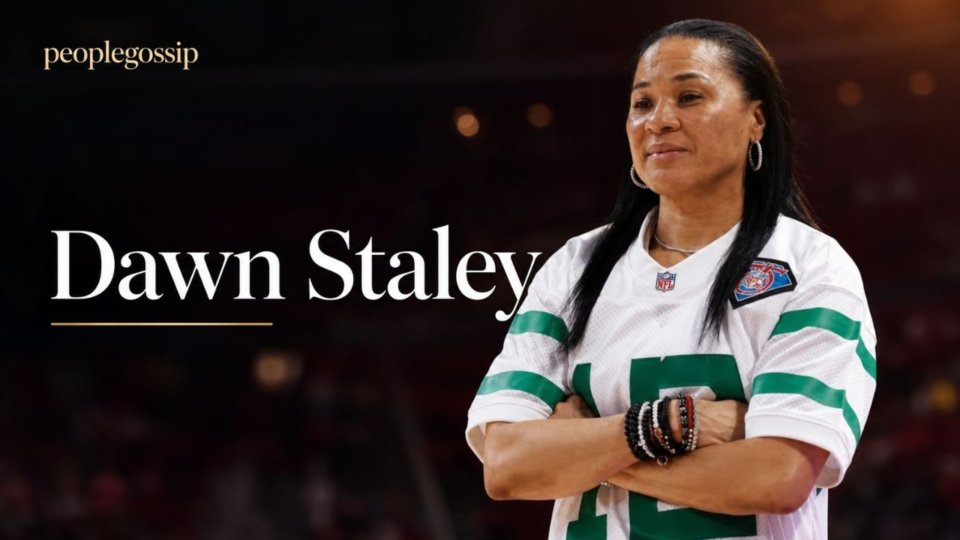
Dawn Staley built her basketball career in two distinct roles. First, she became an accomplished point guard who competed at the collegiate, professional, and international levels. She then carried that experience into coaching, where she developed Temple and South Carolina while also leading the United States women’s national team.
Her record includes three Olympic gold medals as a player, another Olympic gold as a head coach, and three NCAA championships at South Carolina. The path between those achievements was shaped by discipline, relationships, and a willingness to accept professional challenges she had not originally planned to pursue.
North Philadelphia Shaped Her Competitive Foundation
Staley was born in Philadelphia on May 4, 1970, and grew up in the Raymond Rosen housing projects in North Philadelphia. She has spoken directly about the neighborhood and the influence of the environment in which she learned to compete.
Her mother played a central role in that upbringing. Staley described her mother’s approach as a firm combination of discipline, affection and support, with clear rules and expectations for her children.
Those lessons continued to guide Staley when she became a coach. She has described discipline as the ability to resist immediate impulses and develop habits that support a larger goal. Her well-known standards for players therefore come from principles she learned long before entering college basketball.
Virginia Established Staley on the National Stage
Staley played point guard at the University of Virginia from 1988 to 1992. During that period, the Cavaliers reached three consecutive NCAA Final Fours, including a championship-game appearance in 1991.
Although Virginia did not win that final, Staley was selected as the tournament’s Most Outstanding Player. She earned national player-of-the-year honors in both 1991 and 1992. Those collegiate achievements were followed by professional and Olympic playing careers.
Virginia later retired her No. 24. Some of the statistical records she set during her college career have since been surpassed, but her place in the program remains formally recognized by the university.
Professional Basketball Opened a New Chapter
The Charlotte Sting selected Staley with the ninth overall pick in the first round of the 1999 WNBA Draft. She spent eight seasons in the league, playing for Charlotte before finishing her career with the Houston Comets.
According to the WNBA’s official statistics, Staley averaged 8.5 points and 5.1 assists per game across her professional career. Those figures fit the role she had developed as a point guard: directing play, creating opportunities and helping teammates work together.
Part of her professional career overlapped with the beginning of her coaching work. Staley accepted the Temple position in 2000 while still playing in the WNBA, which required her to manage the demands of competing and coaching simultaneously.
Olympic Success Defined Her Playing Legacy
Staley represented the United States at three Olympic Games and won gold each time: Atlanta in 1996, Sydney in 2000 and Athens in 2004.
Her final Olympic appearance included a distinction beyond competition. The United States selected her to carry its flag during the 2004 opening ceremony in Athens. It was a national leadership role given to an athlete whose international career had already covered several major tournaments.
Staley later returned to the national program as a coach.
Temple Turned an Unplanned Decision Into a Coaching Career
Coaching was not part of Staley’s original career plan. She later explained that the opportunity to rebuild Temple attracted her because it presented a difficult challenge. She accepted the head coaching position in 2000 and eventually described it as one of her best decisions.
The results provided a strong foundation for the rest of her coaching career. Temple finished 172–80 during her eight seasons and reached the NCAA Tournament six times. Staley learned that teaching basketball came naturally, but she also discovered that tactical knowledge alone could not create a successful team.
Personal connection became an important part of her approach. She wanted to understand players beyond their immediate roles on the court, building relationships that fostered trust and shared expectations. After eight seasons at Temple, she accepted another rebuilding challenge at South Carolina.
Building a Championship Program at South Carolina
Staley became South Carolina’s head coach in May 2008. The program had not reached the NCAA Tournament in five years, and the leading recruits were generally choosing more established national contenders.
Progress did not arrive as a single breakthrough. South Carolina gradually became a consistent national competitor before winning its first NCAA championship under Staley in 2017. Further titles followed in 2022 and 2024.
The 2023–24 team completed a 38–0 undefeated season, finishing with a championship victory. It was Staley’s third national title as a head coach and placed South Carolina among the small group of women’s programs with at least three championships.
Her teams also reached the Final Four in six consecutive tournaments from 2021 through 2026. Through the 2025–26 season, South Carolina’s official profile listed Staley with a 511–114 record at the university and a 683–194 overall college coaching record.
The latest season ended without another title. South Carolina reached the national championship game on April 5, 2026, but UCLA won 79–51. The Gamecocks finished as national runner-up with 36 victories.
Leading the United States From the Sideline
Staley served as head coach of the United States women’s national team from 2017 to 2021. The appointment made her the first Black head coach of the USA Basketball Women’s Senior National Team.
She guided the United States to gold at the 2018 FIBA World Cup and the 2021 Tokyo Olympic Games. The Olympic victory meant that Staley had won gold for the United States as both a player and a head coach.
Discipline, Trust and People-First Leadership
Staley has described herself as an old-school, disciplined coach who remains willing to adapt to younger players. Her approach is demanding, but it also depends on recognizing each person’s contributions.
Not every player can lead the team in scoring or receive the most playing time. Staley instead tries to make every member of the roster understand the value of her role. She considers that sense of value necessary for preventing individual frustration from damaging the larger group.
Trust developed into another central part of her coaching. Staley wrote that she once kept her guard up and rarely allowed people into vulnerable areas of her life. Her relationships at South Carolina helped her become more open, reinforcing her belief that coaches cannot ask players for honesty without offering trust in return.
Basketball development is only part of the responsibility. Staley has consistently discussed preparing players for professional decisions, difficult personal moments and life after college. Mental development, consistency and decision-making sit alongside physical training in that process.
Using Basketball to Expand Opportunity
Staley recognizes the wider meaning attached to her position. In a first-person essay about Black coaches, she explained that her presence provides young Black women with another visible example of someone who can lead a major program. She has advocated for more coaching opportunities across ethnic backgrounds.
Her public work has also included racial equity and civic engagement. In 2020, she encouraged voter registration and supported honest conversations between teammates about their different experiences. That year, she joined the SEC Council on Racial Equity and Social Justice.
Professional equality is another part of her advocacy. Staley identified asking for equal pay—and later negotiating compensation based on her full value—as two empowering career moments. South Carolina’s Board of Trustees approved an extension in January 2025 worth approximately $25.25 million through the 2029–30 season.
Outside coaching, she is the co-founder and president of INNERSOLE, which provides new sneakers to homeless children and children in need. The Dawn Staley Champions Fund separately supports educational opportunities for first-generation, economically disadvantaged and underrepresented students and student-athletes at South Carolina.
Recognition and a Continuing Coaching Chapter
Staley entered the Women’s Basketball Hall of Fame in 2012 and the Naismith Memorial Basketball Hall of Fame as an individual player in 2013. FIBA formally inducted her into its Hall of Fame as a player in May 2025.
Her 1996 Olympic team received further recognition in April 2026 when the Naismith Hall selected it for the Class of 2026. As of the research cut-off, the formal team enshrinement was scheduled for August 15, 2026.
Other recent developments extended beyond basketball results. Staley published her memoir, Uncommon Favor: Basketball, North Philly, My Mother, and the Life Lessons I Learned from All Three, in May 2025. The book became a New York Times bestseller.
The City of Columbia unveiled a permanent statue of her near the South Carolina campus in April 2025. One year later, she was elected to the American Academy of Arts and Sciences in its public affairs and public policy section.
Conclusion
Staley’s career connects high-level playing experience with sustained coaching responsibility across college and international basketball.
Her coaching work rests on discipline, personal connection and preparation beyond the court. Those principles helped her move from an unplanned coaching opportunity to national championships, international success and a continuing leadership role at South Carolina.