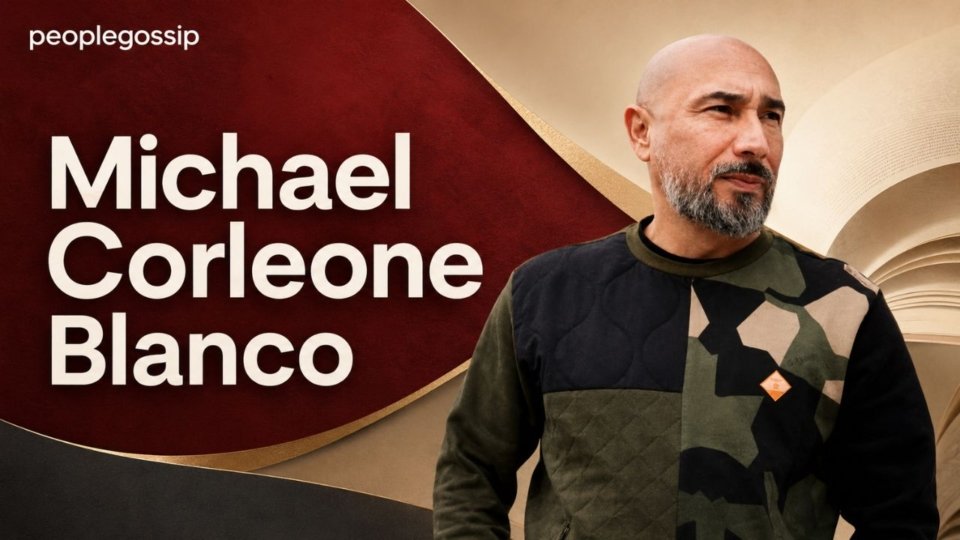
Michael Corleone Blanco is publicly known as the youngest son of Griselda Blanco, but his more recent work has focused on presenting his own account of that family history. Through a memoir, an audiobook, interviews and public appearances, he has described the consequences of growing up around violence and illegal activity while explaining why he chose a different professional direction.
His writing is personal rather than an independently verified history of every event it covers. Still, it provides a direct account of how Blanco understands his past, the decisions that followed and his effort to connect the family name with legal work.
Moving Beyond an Inherited Public Identity
Institutional profiles and reputable reporting identify Blanco as Griselda Blanco’s youngest and only surviving son. Sources disagree about when and how his older brothers died, so their individual stories cannot be presented with the same certainty. His public identity, however, has long been tied to the criminal history associated with his family.
Blanco has acknowledged his own previous involvement in illegal activity. In 2011, he was arrested and charged with cocaine trafficking and conspiracy to traffic cocaine. Contemporary reporting states that he pleaded not guilty and remained under house arrest while awaiting trial in 2012. A later interview reported that his probation ended in 2018, although accessible records do not clearly establish the final plea, judgment or sentence.
His movement toward legal work began before the publication of his memoir. Florida records show that Michael Blanco and Mike Yuen were listed as managers of Pure Blanco LLC, formed in 2015. A related clothing mark received federal registration in 2019 with Michael’s consent to the use of his name. The Florida company was administratively dissolved in September 2024, and the records do not establish whether related products continue through another entity.
Writing eventually became a central part of how Michael Corleone Blanco addressed his inherited public identity. Rather than allowing documentaries and dramatized accounts to define the family story completely, he began using books, interviews and media collaborations to present his own version.
The Turning Point Behind His New Direction
Blanco has identified his mother’s death on September 3, 2012, as a major turning point. In a 2019 interview, he said the loss forced him to consider the repeated violence surrounding his family and how remaining in that environment could affect his children.
According to his account, money no longer justified continuing the same way of life. He wanted his children to understand that income could be earned legally, an idea he later described as part of breaking a damaging generational cycle. That description represents his assessment of his own progress rather than an independent judgment about every part of his life.
His effort to confront the past also appeared publicly in 2019, when a television episode documented him beginning therapy after an emotional visit to Colombia. In that program, Blanco discussed his father’s death, which he has said he witnessed. The program confirmed that he started therapy at that time, though it did not establish how long the treatment continued.
These experiences became part of the personal history he later chose to put into writing. Blanco has described legal media and business work as a way to move beyond the identity created by his family background without pretending that the past did not exist.
Turning Personal History Into a Memoir
In 2024, Blanco published My Mother, the Godmother: The True Story of Michael Corleone Blanco, the Son of Griselda Blanco. The memoir recounts his childhood, family history and experience of living around the drug trade. It also presents his explanation of how he moved toward legal work.
Blanco and the book’s promotional material frame the memoir as more than a record of family events. Its stated purpose is to warn readers about the human consequences of drug trafficking, corruption and violence, particularly the effects passed from one generation to another.
That approach differs from simply celebrating the notoriety attached to the Blanco name. His account focuses on loss, fear, and the personal cost of a criminal environment. Blanco has said that his current work allows him to use experiences from his former life within lawful media projects.
As a memoir, the book represents his memory and perspective. Its publication and his authorship are confirmed, but private conversations and disputed family events described within it are not automatically established as historical fact. Claims involving responsibility for particular deaths are especially limited by missing or conflicting records.
The memoir nevertheless gave Blanco a structured way to tell his story in his own voice. It also created a foundation for later audio work, interviews and public conversations about how his family has been portrayed.
Extending the Story Through Audio and Public Conversation
Blanco continued that work after the print publication. An unabridged audiobook was released on February 24, 2025, with him credited as both author and narrator. The recording runs for 14 hours and 54 minutes, allowing him to deliver the account directly rather than leave its presentation to another narrator.
His public speaking followed a similar direction on September 26, 2024, when he appeared as the featured speaker at a sold-out Mob Museum program about escaping the shadow of his mother’s drug empire.
The Mob Museum later released an 83-minute interview with Blanco on June 5, 2025. He discussed his childhood, former illegal activity and transition toward legal work. The interview is valuable as a first-person account, but the museum notes that factual assertions made by guests are not independently vetted.
Blanco’s recent verified public work includes authorship, narration, speaking and interviews. His memoir carries a cautionary message, but no organizational record establishes that he operates a formal charity or nonprofit advocacy program.
Reconsidering Earlier Media Rivalries
Blanco’s relationship with filmmaker Billy Corben provides another part of his professional development. He told Business Insider that he initially regarded Corben and his collaborators as rivals because they reached audiences with the Blanco story before he did.
Their early encounters occurred around 2006 and 2007. By 2019, Blanco had begun to view the situation differently and thanked Corben for helping create public interest in the family history. The earlier competition eventually became a professional collaboration.
In 2024, they worked together on The Real Griselda, a podcast that compared family accounts with a fictionalized Netflix portrayal. Blanco contributed his own memories and objections, while Corben brought his previous work documenting the subject.
Blanco has also said that recognizing his former world had disappeared led him to use his experiences through legal media work. His partnership with Corben marked a change from viewing him as a rival to working alongside him.
Challenging How the Blanco Family Was Portrayed
Blanco’s desire for greater control over the family narrative also became a legal dispute. After watching Netflix’s fictionalized portrayal of his mother, he described experiencing mixed emotions and argued that the complexity of the family history deserved more context.
On January 17, 2024, Michael and Marie filed a lawsuit in Miami-Dade County against Netflix, Sofía Vergara and other parties. They alleged that family identities and material had been used without authorization. The allegation represented the plaintiffs’ position and was not established by a court ruling.
Their counsel dismissed the complaint with prejudice on February 9, 2024. Some reputable reports described the outcome as a settlement, but the confirmed procedural event is the dismissal. Any private terms were not disclosed.
Because the case ended without a public judgment on its merits, the outcome did not prove that the defendants had improperly used Blanco’s material. It also did not establish that his underlying allegations were false. The dispute instead documents how strongly he wanted to participate in decisions about the presentation of his family history.
His response also clarifies the role of the memoir and podcast. Both gave him direct channels for adding detail, disputing portrayals and explaining events from his perspective without relying entirely on a fictionalized production.
Writing as Michael Corleone Blanco’s Chosen Path Forward
Writing now gives Michael Corleone Blanco a direct way to address the legacy attached to his name and connect his family account with his stated move toward legal work.
His account does not resolve every disputed event connected with the Blanco family, and personal recollections cannot replace missing court or civil records. Its clearest value lies in documenting how he describes his own change in direction.
Blanco’s writing neither removes the past nor separates him completely from his mother’s public legacy. Instead, it gives him a way to address that history in his own words, connect it with his stated concern for the next generation and present legal storytelling as the work through which he intends to move forward.